Showing posts with label FaceBook. Show all posts

Facebook & Youtube Shut Down in Pakistan

.
Islamabad: PTA has directed all concerned operators to shut down website www.youtube.com in view of growing sacrilegious contents on it. It may be mentioned that PTA after all possible avenues were used within its jurisdiction, including using regular channels available on the FACEBOOK and YOUTUBE to launch protest, to avoid appearances of derogatory material available on their websites - which increased in numbers as time passed by, that PTA decided to completely shut down these sites from being viewed within Pakistan. PTA has so far blocked more than 450 links on internet containing derogatory material.

It was not only in line with the Constitution of Pakistan, the wishes of the people of Pakistan but also an extension of the court orders passed by the honorable High Court of Pakistan and directions of the Government of Pakistan. PTA has already announced a phone number and a complaint number to receive complaints on the issue.

The attitude of administrators at FACEBOOK and YOUTUBE was in contravention to the WSIS Resolutions and their own policies advertised on the web for general public. PTA would welcome the concerned authorities of FACEBOOK and YOUTUBE to contact the PTA for resolving the issue at the earliest which ensures religious harmony and respect.
.

Connecting with Chuck Martin: The Facebook Grader

At Facebook, we're constantly connecting with interesting people—from experts and researchers to celebrities or visitors to our office. Occasionally, we'll share these conversations on the Facebook blog in our "Connecting with..." series.


Chuck Martin and a team of researchers from the University of New Hampshire's Whittemore School of Business & Economics recently found that the amount of time students spend using social media and services like Facebook does not affect their grades. I talked with Martin, a lecturer at the school and the CEO of organizational research firm NFI Research, about those findings as well the use of social media in his classroom and its impact on the workplace. Martin is the author of eight business books, including his soon-to-be released "Work Your Strengths."


You and a team of researchers recently looked at the correlation between using social media and grades. What would you say is the big finding from your perspective?


Martin
The big finding is that there is actually no correlation between the amount of time that students spend using social media and their grades. We found that basically the heavy users and the light users get pretty much the same grades.


In addition to the finding that there isn't a correlation, what were some of the results about just how much students are using social media?

For the purposes of the study, we considered social media to be Facebook, YouTube, blogs, Twitter, MySpace and LinkedIn.... This study was very wide. It was 1,100-plus students out of the 12,000 at the university, and we surveyed every college at the university.

But of the heavy users of social media, 63 percent got high grades, and of the light users, 65 percent got high grades. So there is no real difference between the two. And of the heavy Facebook users, 62 percent got high grades. The light Facebook users, 62 percent got high grades. It was identical.


And did that surprise you?


It didn't. Interestingly, the hypothesis of the students was that there would be no correlation and they were correct. But if you talk to any adults, adults were totally surprised by this. And adults and parents typically have the view that you need to spend more time on your homework and less time on your social media so that your grades stay high. Well, it turns out that it makes no difference.


Why do you think there is this disconnect? Is this just a generational gap, or something about how people use (social media) differently?


It's not just generational, it's actually behavioral. If you look at the students today, they have grown up with things like Facebook and YouTube and blogs and so forth, so it's not a separate thing. In the early days of the web, people would be at work or school and they would start surfing the web and two hours later they would come back and say, "What was I looking for? I forgot."

They basically got lost in the experience, and today with social media it's actually become integrated with people's lives. So it's not a separate thing where people leave life and go do (social media). It actually has become part of what they do every day....


They have a multitasking ability that's a little different?


I created a course for the university called "Social Media in Marketing." (During class) we had my presentation on the screen live, and we were dipping in and out of the web. We had a live Twitter feed projected to a large screen, and we had a third screen with another projection, where we had a back channel so that people could communicate anonymously on the big screen.... There were three big screens in front of the classroom with three live network feeds, and we also had video and we had people patched in by Skype.

Everybody in the room used a computer for the entire three-hour class, and they were encouraged and actually did interact. They were tweeting with people around the country during the class about the content, and people were tweeting from outside the classroom from different parts of the country with questions that we would then tackle as a group.

And it turns out that the engagement level of the students was higher than a traditional classroom. We talked to a neuropsychologist, who is actually one of my co-authors, about this multitasking aspect and his view was that it's not really multitasking. It's really using different media simultaneously on the same subject matter.


That's really fascinating because the conventional wisdom is, "Oh, this is just a distraction from paying attention to the lecture."


Right, we had people come in and monitor the class. We had trustees or we had the finance people, and they were all astounded by what they were seeing. Every class was longer than it was supposed to be because we couldn't really get the students to stop.


Do you find that it extends the conversation outside the actual class, and are there other ways of using things like Facebook beyond the lecture?


We actually, for that course, ran the course on Facebook.... Since this was social media, we decided that we needed to use social media and we created the course on a private (Facebook) group. So all of the members of the class were in the group, and then each of the (study) groups created their own Facebook groups for their teams. The difference between that and a traditional course was the course then ran 24/7 because people were having conversations about the content all the time.... We will be teaching this course again in the summer and will be using Facebook for that as well.


Thinking further out, though, do you think that more classrooms will begin to adopt this idea of using social media both in the class and outside?


When we were doing the social media course...we had requests from outside the classroom from other parts of the country that they wanted a live streaming feed. So one time we just streamed it live onto the Net, and that's because of the demand. It's not necessarily because the teacher said he wished to do this. It's because the market said, "Hey, we should do this." Once you use the back channel in a classroom, for example, and it's highly interactive, it's difficult not to have it.


Where do you see Facebook and social media fitting into the workplace moving forward? What would be your advice to business leaders?


Let (employees) do it and encourage it. It's just like in the classroom: The great fear of adults for our class was that (we would have) all these people behind computer screens and that they weren't going to be paying attention to the class (but) going to be shopping and doing all these other things online.

Nobody did that, nobody. It just didn't happen, and if that happened it would mean that I was failing as a teacher.

It's the same thing in business. If you let your employees do their work more effectively, they will work more effectively.


Matt, a manager on Facebook's communications team, passed paper notes as a back channel when he was in school.
. .

Faces of Facebook: The Social Side of Public Policy

We're introducing a new series today called "Faces of Facebook," which features excerpts from interviews with our employees that originally appeared on our internal blog. Their words offer a glimpse of life inside of Facebook and the work they do around the world.


Adam Conner was the first member of our Washington, D.C., office when he joined Facebook in November 2007. He works on the public policy team as one of Facebook's official D.C. lobbyists. He is originally from Los Alamos, N.M., and is a little broken up over Conan O'Brien right now.

You send a lot of social emails and show up at all our company parties. (Social is an internal email list where employees discuss social topics such as finding concert tickets, a new apartment or teammates for a pickup game of basketball). What do you do in your spare time?


Conner with U.S. President Barack Obama.
Sigh, the party thing used to be the case but not any longer, I've missed the last two holiday parties. But I did manage to be around for Game Day last year, which was awesome (Game Day is an annual Facebook tradition where employees spend a day competing in teams in a series of outdoor games).

I'm a pretty social person and have always worked around a lot of people; but when I first started working for Facebook I worked by myself from my apartment. If I had worked for any other company I think I probably would've gone insane. But being constantly on Facebook (the product) with all of Facebook (the company) let me feel like a part of the company in a real way. Social (email) was kind of the same way and I've never seen anything like social anywhere else I've worked.


Describe a moment where you felt that your work was making a difference in the world.


The week of January 11-17 was pretty cool, helping to pull together the Global Disaster Relief Page in just few hours. I went on vacation that weekend and was on the phone in Mexico convincing President Clinton to plug our Facebook page as part of the relief efforts.

Election Day in 2008 was pretty cool, too. We'd registered 60,000 voters in just 10 days with ads on the site, got 5.5 million U.S. users to click the "I Voted" button on Election Day, and had something like a million users look up their polling location on the Google Map. That was when I realized the high point of my professional career in politics was going to be getting 5.5 million people to click a button.


When you applied to work here, what crazy rumor about Facebook culture did you initially dismiss, only to discover that it's completely true?


I knew almost nothing about Facebook when I joined. I was like a lot of people who don't seem to conceive of the idea that people work at Facebook and not magical computer fairies.


Why do you work for Facebook, over any other options open to you right now?


I really love my job. I get to sit in meetings with vaguely important and occasionally actually important people and explain why Facebook is like the wheel or fire and how not using it really isn't an option anymore. Government and politics both operate with pretty limited resources, but technologies like Facebook really are an answer for helping them overcome those constraints.

I came to DC to be a character in the (American TV show) West Wing (like Sam or Josh) and there are times when it was hard to look at all my friends working on the Obama campaign or in the White House and not feel like I'm missing out. But Congress, the White House, the government—those have all been around for a while and will be around for a while longer.

Facebook is a once-in-a-lifetime opportunity. It's like my favorite Facebook philosopher, (engineer) Soleio, once said (in this video): "This is Everest. Like there's nothing else, you get this thing done, you do this thing well, and then you can go home. You can say 'Hey I changed the world.' ". .

Facebook Neighbors Reunite Dog with Owner


The following is part of our "Your Stories" series on different ways Facebook is used across the world. If you have a story you'd like to share with us, please submit it here.


David Slade's fiancée Kelly was the first to find the lost little dog. Standing in the driveway on her way to shop for wedding dresses in January, Kelly was surprised when the disoriented animal cheerfully ran up to her. Kelly brought the pup, which she nicknamed "Mouse," inside from the incoming rainstorm to play with her and David's own dogs. She left David to begin searching for the owner of the lost pet alone.

Neither Kelly nor David could have guessed that Facebook would play an integral role in the effort to reunite Mouse with his family.

The dog was wearing a collar, but no tags, leaving David unsure where to begin his search for the owner. Initially, he pursued traditional methods by calling the neighborhood vet and the Humane Society, leaving a phone number and a description of Mouse in case anyone had called to inquire. Once the storm clouds parted, he even went door-to-door in the area surrounding his home, but was frustrated when he realized that many neighbors owned similar small white dogs and all of them seemed to be accounted for.

The following day, David knew it was time to take a different approach. Fortunately, his neighborhood of Hillcrest, a small, older area within Little Rock, Ark., has an active Facebook Page with nearly 2,500 fans. David posted a photo of Mouse, along with the following short message to the Page's Wall.


Amazingly, within only a few hours, a woman named Lin Chan commented: "That's our TYSON! Thank you!"

Lin had been alerted to David's post by a phone call from a friend who had seen the post. "I quickly logged onto Facebook and was relieved and in disbelief when I saw Tyson's photo posted by David," Chan said. "My son, who is 4, actually cried when he saw the photo because he 'wanted Tyson home now'."

David and Kelly quickly contacted Lin after they saw her comment, and their Mouse, who was actually Tyson, was returned to the arms of Lin and her two sons in no time. During the search, David remembered a cell phone commercial he'd seen, where a picture of a lost dog is sent around town by text message and leads to the dog being returned to his owner.

"I remember thinking 'if only it were that easy,'" David said. "Turns out it is."


Sara, an intern on Facebook's communications team, wishes she and her roommate could adopt a lost puppy.

Romantic Tales from the News Feed

As part of our "Your Stories" series on different ways Facebook is used around the world, we are featuring stories in celebration of Valentine's Day this Sunday from people who found love and nurtured romances on Facebook. If you have a story you'd like to share with us, please submit it here.

Love on the Wall


After an unexpected divorce, Jenece Whitted was discouraged by the prospect of finding love again. She decided in February 2009 to post a status update on Facebook voicing her frustration with the "game" of dating, and she was surprised when an old friend from elementary school, Adam, commented in agreement. The two began chatting on Facebook, discussing Adam's talent as a comics artist and which strips he thought were appropriate for Jenece's 7-year-old son.
The finale from Adam's comic.
Chatting soon led to texting, which led to talking on the phone, and before a week had passed Adam had booked a flight from California to Arizona to visit. It was love at first sight for Jenece, as well as her two sons, who were thrilled with Adam's knowledge of Star Wars and Super-Heroes. Adam moved to Arizona at the end of May, and in September he found a unique way to pop the question.

"I woke up in the morning and checked Facebook like I always do," said Jenece, who noticed a new picture on Adam's Wall. "I clicked on it, thinking he had just drawn another comic."

This was no ordinary picture, though; it was Adam's proposal.

"I read it and when I turned to look at him he had the ring out…it was so sweet," recalls Jenece. "He is definitely one in a million!"

The two are planning a June 2010 wedding.

High School Reunion


After his wife of 33 years passed away in January 2009, Mike Sullivan joined Facebook hoping to reconnect with old running buddies and friends who could help him overcome his grief. Little did he know that he would find more than friendship.

After recognizing a woman he went to high school with, named Terri, Mike began exchanging messages with her on Facebook about old memories and their lives since high school. Terri, who had been divorced for four years, lived in a town only about three hours from Mike, and one day they agreed to meet halfway in Ranger, Texas.
Terri and Mike
"We sat in my truck for about five hours talking about old times, looking at the high school annuals she brought," Mike said. "When we decided it was time for us to go, I kissed her and knew there was a very special connection between us. I smiled all the way back home."

Today, Mike credits Terri with helping him cope from the loss of his wife, saying he would have had a much harder time without her there for support. It will be even easier for Mike to be by Terri's side in March, when he plans to move to her town and begin a new job. For this couple, there is a lot to look forward to this Valentine's Day.

Fire Drill Romance


On the evening of Nov. 6, 2008, Kate Lovett was in the middle of a theology exam at Brigham Young University. Suddenly, the fire alarms sounded, requiring her and the entire testing center to evacuate.

Though the timing was less than ideal, Kate's misfortune was lessened when she met a handsome stranger during the drill—a fellow student whose transportation engineering exam also was interrupted. When everyone returned indoors, Kate parted ways with her new acquaintance.
Kate and Alexander
"I knew I wanted to get to know him better, but all I had was his first name, hometown and major," she said.

To Kate's delight and surprise, she was able to find him on Facebook immediately after her exam ended. Although Kate checked out his profile, she didn't attempt to connect with him further until several months later. She finally sent him a Facebook message asking him to go to lunch the following day. Thankfully, he agreed, and the two began dating soon afterward.

Kate is happy to say that because of Facebook, and a pesky fire alarm, she can now call that handsome engineering student her husband.

10 ways Microsoft can save Windows Mobile -- starting NEXT WEEK!

What will Microsoft CEO Steve Ballmer announce during Monday's Mobile World Congress press event in Barcelona, Spain? There's what he will announce and what he should. I'm skipping the speculation about what and going right to should. Microsoft's mobile strategy is a mess. Apple and Google have routed Microsoft in mobile operating systems. Android and iPhone OS make Windows Mobile look about as fresh as Windows 95. Meanwhile, Microsoft has chased Research in Motion's BlackBerry in the enterprise for years, never making any real gains.
It's long past time for the Big Ballmer to step up and offer something substantial -- not promises of future technology coming but goodies available immediately or nearly so. I've condensed what easily was a list of 15 or so items down to 10 things Microsoft must do immediately to save Windows Mobile from extinction. Microsoft has no more time. It's do or die, and even doing now may be too late. With that introduction, Microsoft should:
1. Release Windows Mobile 7. That's not announce but release, either next week or within 60 days. Anything less than immediate or near-immediate timing is simply too long. Google's Android is on rapid development and end-user adoption pace now, and Apple is sure to release a new iPhone model by summer. Meanwhile, Windows Mobile continues its decline. Gartner and IDC haven't yet released worldwide smartphone OS shipments for fourth quarter, but ComScore has released US phone subscriber share, based on a survey of more than 30,000 mobile users. Android phone share (based on actual subscribers not shipments) was 5.2 percent in fourth quarter, up from 2.5 percent sequentially. Share by phone OS vendor: RIM, 41.6 percent; Apple, 25.3 percent; Microsoft, 18 percent.
Ballmer will make a huge mistake if all he has is something to show. He can drone on about how much better is the Windows 7 Mobile user interface or blow about natural user interface enhancements. Big fraking deal. Microsoft's theme for Windows Phone at MWC is "Ready. Set." If Windows 7 isn't ready, set, go, Ballmer should stay in Washington State (or fly back if he already is in Spain).
2. Announce Zune phone -- or, at least, a handset based on Danger technology. Of course, Microsoft should do its own phone. A Danger phone -- the so-called "Project Pink" -- would be something better than nothing, but a Zune phone would be much better. Sure Microsoft risks alienating some of its OEM partners, but many of them are pulling back Windows Mobile in favor of Android anyway. Microsoft risks more by doing nothing.
In my September review of Zune HD, I wrote:
The Zune HD's size, particularly its thinness, would be ideal for a cell phone -- way better suited than iPhone. With a 3G radio, Bluetooth and application store, Zune HD could be a helluva phone. The task-oriented user interface, while very non-phone like, is ideally suited for a multi-functional device, even one with 3G telephony. Task-oriented UIs emphasize simplicity and hide complexity, increasing usability.
That's self-explanatory enough as to why a Zune phone makes sense.
3. Make a major mobile acquisition. I expect that Windows 7 Mobile or Zune phone won't be ready come Monday, and Microsoft simply can't afford to wait. Even if Windows Mobile 7 released to manufacturing next week, new handsets would still be months away -- at least. Microsoft needs to acquire some company with good mobile hardware, software and services. Kara Swisher made similar suggestion on February 8:
Microsoft and its giant wallet might be better served by buying one of the big and more established telecom companies, such as Research in Motion, Palm  or even -- as another Microsoft exec said to me, 'Why not?' Nokia. Nokia has a market cap of close to $50 billion, with RIM at close to $38 billion. And Palm? A paltry $1.74 billion. Microsoft's current valuation is $246 billion, and the company has $40 billion in cash and marketable securities on hand...many sources at Microsoft have told me that CEO Steve Ballmer has expressed interest in buying RIM many times (while also dismissing any interest in Palm).
In late December I stated "10 reasons why Microsoft should buy Palm now." Maybe Ballmer has hard feelings about Palm because of past competition and the short-lived commitment to Windows Mobile. If so, he should act logically, not emotionally. Palm would be a cheap acquisition that would instantly give Microsoft great hardware (Pre), operating system (WebOS) and services, particularly synchronization. RIM and Windows Phone overlap too much in the enterprise. Microsoft needs some consumer pull, and Palm has it. What Palm doesn't have is a strong company backing its great technology. Microsoft could provide that.
4. If no Zune phone or mobile acquisition, announce Windows Phone handset development contest.something. Microsoft should announce a contest to develop the Windows 7 Phone. Major manufacturers, startups and individuals should be allowed to submit prototypes (with all appropriate NDAs and contracts in place to protect designs). The contest must last no more than 120 days (Hey, it's a Manhattan Project!), with Microsoft committed to choosing one to three designs within 30 days and begin manufacturing 30 days later. Microsoft would commit to buying the prototype design for pre-stated price and -- for existing, major manufacturers -- promising exclusive production deal for at least 12 months. Microsoft needs a Manhattan Project for mobile. If the company has got nothing, it should encourage third parties to come up with
The contest would be worth the buzz alone -- and there should be plenty of that. Suddenly anyone could conceivably develop Microsoft's own Windows Phone and get a big, fat contract in process. The Web would buzz with speculation and ideas about what Microsoft should do. The contest could be the ultimate in crowdsourcing but instead of culling the crowd for free Microsoft could put forth its longstanding corporate axiom that people should be paid for their creative work. Take that, free-monger Google!
5. If no mobile acquisition or Zune phone, make closer development, strategic and business ties with Nokia. Barcelona is the right place, given Nokia's handset dominance across major parts of Europe, the Middle East, Asia and Africa. Buying Nokia wouldn't be a bad idea, either, as Swisher suggested.
In most emerging markets, the mobile handset is the first Internet-connected device, not the PC, that most people first use. During fourth quarter, Nokia sold 126.9 million handsets worldwide for 39 percent worldwide market share. Worldwide, there are 4.6 billion mobile phone subscribers, and manufacturers ship about 1.3 billion mobile phones each year. By comparison, the total PC install base is only about 1 billion.
The point: The future of computing is the mobile device, not the PC. Nokia has huge presence in most countries, particularly emerging markets. A Nokia deal, or acquisition, should emphasize extending Microsoft products and services to cell phone users in these markets. Microsoft also should align any Nokia deal with the "Unlimited Potential" program.
6. Release -- not announce -- a new mobile browser. The browser should be based on Internet Explorer 8 or WebKit, and it should be available for all major mobile platforms, starting with BlackBerry OS, iPhone OS, Symbian OS and Windows Mobile. It's OK if Microsoft snubs nose at Android -- for now. Microsoft's new browser should be available in beta, at least.
7. Unveil Zune Silverlight client. As big as Windows market share is, Microsoft needs to extend Zune's reach, particularly to sell more music players or to launch a phone. Microsoft should release a Zune client for Mac -- and even Linux -- and that could be easily enough done with Silverlight. Microsoft could go all Web-based, but the Zune UI and features are already compelling in the Windows client. That said , Silverlight could allow for the option of both -- Web-based and desktop clients.
8. Release Silverlight for Mobile. In two years, HTML 5 could make Silverlight less relevant, not just Adobe Flash. Microsoft already is off to good start supporting HTML 5 streaming with Silverlight. What Microsoft needs more is a Silverlight client for all major mobile platforms, including iPhone OS. Windows Mobile won't be near good enough. Support must be broad, starting with Symbian S40 and S60 handsets. Microsoft should make beating Flash to market a top mobile development priority. Flash 10.1 is nearly ready for mobile device release and could debut as early as next week.
9. Tag it! Barcodes have a huge future on mobile devices, and so far only Nokia really gets it. But Nokia is lumbering too slowly to market. Google also gets tags, for search and advertising, but misses the broader utility in emerging markets. Enter Microsoft Tag. Mobile money is the hot topic in emerging markets. The idea: That people spend and also receive money via accounts attached to their mobile phones. Mobile phones also could be used for distributing financial aid.
In emerging markets where people don't otherwise bank, the mobile phone can contain funds access and be used to pay for items. On possible future payment option: Scanning barcodes with the phone's camera. Microsoft already is an aggressive technology provider in emerging markets. Mobile money tied to Microsoft Tag would be glue binding new customers to the company's products and services.
10. Make mobile location-based search immediately available. Google is there now. Mcrosoft's Bing needs to offer even better location-based search services -- tied to advertising and maps, for starters. Nirvana: Jack Consumer searches for Patti Smith book Just Kids, on his computer. While out and about, his smartphone beeps and, based on location and store database stored in the Azure cloud, informs that the Borders shop on the next block has Just Kidsin stock.


How to Track Your Favorite Pages on Facebook

There are generally two reasons why people fan pages on Facebook.
You love a particular product and by becoming a fan, you can show your appreciation for that product to the world. That is one of the reasons why I am a fan of Google, O’Reilly, Creative Commons, and a dozen other pages on Facebook. I also admire the work of people like David Pogue and Matt Mullenweg and hence have become a fan of them on Facebook as well.
The other popular reason why people become fans of Facebook pages is because they get access to official news updates, videos and even exclusive deals. For instance, if you become a fan of iTunes, you get to download some 20 songs for free. Bing uses their Facebook page to showcase new cashback offers while office supplier chain Staples uses Facebook to share coupons and upcoming deals.
The Problem with Facebook Pages
Facebook probably has millions of pages (anyone can create any number of pages) but you can use this link – facebook.com/pages – to browse through the entire list sorted by categories and popularity.
When you become a fan of any particular page on Facebook, the Facebook system will treat that page like one of your friends. That means any updates from the Facebook page will appear in your regular news feed and therefore the probability that you may miss seeing that important update becomes very high especially when you have a huge network of friends on Facebook.
The solution is however simple – you can either add your favorite Facebook pages to your browser bookmarks and make it a point to visit them once per day or, for something more simple, try the following services.

Track Facebook Pages via Email or RSS

One of my favorite services for tracking Facebook Pages is NutshellMail (they do twitter equally well).
You just have to link Facebook with NutshellMail using Facebook Connect (no need to share your password anywhere) and the service will send you a daily snapshot of Facebook pages that you are a fan of.
Get Facebook Pages via Email
While it can track all your Facebook pages, it may be a good idea to select only a limited number of “important pages” for track else the daily email message can run into a few Megs because the email will have everything that’s posted on the wall of that Facebook page. Founder Mark Schmulen told me that they are working on excluding “user” comments from the updates but that’s not done yet.
If you like to track only “official” updates from Facebook pages and not the comments written by “fans”, you should use the RSS option. Facebook now provide RSS feeds for all their pages that only include updates, videos, pictures, etc. posted the page admins.
For instance, the feed for Digital Inspiration page is available here. The URL will have a similar structure for all pages but for the page ID. You can subscribe to RSS updates in Google Reader or use a service like FeedMyInbox / FeedBlitz to get Facebook updates directly in your email inbox.
Facebook Pages RSS Feed

Creating Your Personalized News Channel

A few weeks ago, I was working from home when my News Feed suddenly became inundated with status updates about a small earthquake that briefly shook near Facebook's headquarters in Palo Alto, Calif. Though I was only about 40 miles away, I didn't feel the quake but still heard about it as it happened thanks to the posts of my friends and coworkers. My News Feed became my source of news before any outlet had a chance to cover the event.

As news quickly travels, your friends are often the best filters you have for surfacing meaningful news. They are how I heard about Michael Jackson's death, President Obama's Nobel Peace Prize and even "Balloon Boy."

Whether it's a minor event like the small earthquake in the Bay Area or something as life-altering as the recent tragedy in Haiti, you can turn to Facebook to share news, connect with news outlets and discuss current events with others. The news you read on Facebook can be as diverse as the friends and news media you connect with.


When the earthquake hit Haiti, victims in the area, news affiliates and people around the world used Facebook to learn what was happening, connect with loved ones and quickly disseminate information. ABCNews.com and France 24 added Facebook live stream boxes to their sites to enable people to share their feelings on the disaster and relief efforts, and publish it back to their Facebook status. Meanwhile, The New York Times created a special Facebook Page dedicated to Haiti coverage, resources and updates from their reporters on the ground.


Clearing the Clutter


In this era of social news, information is more ubiquitous than ever before and the rate at which we consume and share news has never been quicker. Your friends on Facebook help you cut through the clutter so you can read what's most relevant to you, discover new items and carry on thoughtful discussions.

Just as your friends can post news throughout the day, so do many news outlets. By connecting with their Facebook Pages, you can stay updated and interact with outlets such as The New York Times, The Guardian and CNN, and directly with reporters and anchors such as Katie Couric of the CBS Evening News and CNBC's Nicole Lapin.

At any given time, the news on your home page can consist of celebrity gossip posted by your sister, sports scores from the ESPN Page, and a political debate among your friends as they cite their favorite blogs. With so much information at your fingertips on one site, Facebook can serve as your personalized news channel.

You can even create a "News" list to filter news-oriented Pages into one view on your News Feed. Simply add relevant Pages to the list, just as you would with a friends list. The next time you sign on to Facebook, you can click the "News" filter to see stories from all of the news outlets of which you've become a fan.


Connecting with News Everywhere


In addition to reading news on Facebook, you can share news with your friends on external sites with Facebook Connect. Outlets like The Huffington Post, The Washington Post, USA Today and countless blogs have become more social by adding Facebook Connect to their websites and iPhone applications. You can sign in with your Facebook login to see what articles your friends are reading and comment on articles with your authentic identity.

Startups are also using the power of Facebook Connect to provide social news experiences. Daily Perfect is a personalized news website that you can sign into with Facebook Connect, and it will deliver news tailored to you based on your Facebook profile. For example, I've included in my Facebook profile that my interests are "San Francisco," "technology" and "religion," and Daily Perfect surfaces current affairs related to those interests.

Join the cycle of sharing news with your friends on Facebook and off by posting news, commenting on the links your friends post, and checking out news organizations that are using Facebook Connect or have created Facebook Pages to build a well-rounded collection of news for yourself.

For more examples of how news organizations are using Facebook, become a fan of the News on Facebook.

Facebook Toolbar Speaks New Languages

No matter where you are on the web, you can stay close and share with your friends through the Facebook Toolbar. Originally launched in English for the Firefox browser, we now have released an Internet Explorer version of the toolbar and made both versions available in a total of 16 languages.

You can use the toolbar to easily visit the most common sections and applications on Facebook, including your home page, profile and Inbox. You also can see how many friend requests, Inbox message and event and group invitations you have from icons near the top of your browser, and then click to view them.


When you find an interesting news story, funny video or other content you like on the web, click the "Share" button on the toolbar to share it with your friends on your Facebook. The toolbar even gives you a quick way to upload photos to your profile.

The languages now supported are Arabic, Chinese (simple and traditional), Danish, Dutch, German, Spanish (Spain and international), French, Hebrew, Indonesian, Italian, Japanese, Portuguese (Brazilian), Swedish and Turkish. You can download the latest Facebook Toolbar for Firefox or Internet Explorer here.

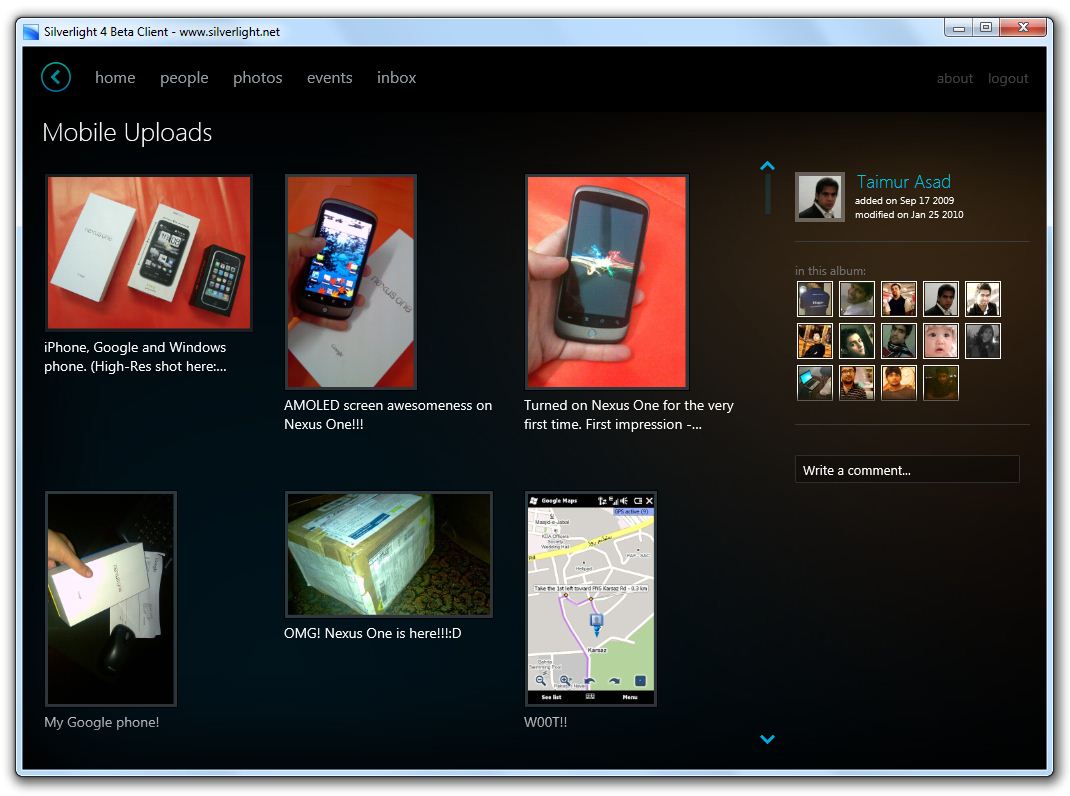
Silverlight 4 Facebook Client Released for Windows and Mac

Microsoft has just released Silverlight 4 based facebook client for both Windows and Mac OS X. Back in April last year, Microsoft showed off a proof of concept facebook client which was made using facebook’s Open Stream API on Silverlight but unfortunately that never saw the light of the day. After a long wait, they have finally released a fully working client for users running Windows and OS X – with full capability to run it out-of-the-browser.
Facebook - Silverlight 4 Beta Client
This application brings together the many compelling platform capabilities of Silverlight 4 into a rich out-of-browser application in the familiar context of Facebook. Enjoy the photos, feeds, events, friends’ walls, and inbox mail from your Facebook account in an appealing and user-friendly environment.
Some of the features of the client are as follows:
  • Out-of-browser support
  • Hosting HTML content interactively
  • Local Device access (webcam)
  • Rich-Text control
  • Embedding alternative media content (i.e., YouTube)
  • Desktop notifications
  • COM integration (with Outlook) on the Windows platform
  • Right-click
  • Drag-n-drop
  • Window control
  • Animations
Facebook - Silverlight 4 Beta Client
To try out this Silverlight 4 based facebook client, head over to the official Silverlight page to download and install Silverlight 4 Beta for your respective platform.
Here is a short video, published by ithinkdifferent blog which shows the touch features of the app in action on a Windows 7 PC.

Silverlight 4 Beta, Visual Studio 2010 Beta and .NET Framework 4.0 were all released back in October last year.
You can follow me on twitter or join our facebook fanpage to keep yourself updated on all the latest from Microsoft, Google and Apple.

Facebook Snatches User’s Vanity URL And Sells It To Harman International

This looks really, really bad. An avid Facebook user named Harman Bajwa says that his Facebook vanity Url – Facebook.com/Harman – was unceremoniously revoked yesterday for violating Facebook’s policies. His new Facebook URL is the much less memorable facebook.com/profile.php?id=538612932.
Facebook then apparently did a sales deal around the vanity URL with Harman International.
The notice from Facebook (also in image at bottom of post):
Please Read This!
Warning
The username you selected was removed for violating Facebook’s policies. A Facebook username should have a clear connection to one’s identity. In addition, impersonating anyone or anything is prohibited. If you see other people with usernames that do not accurately represent their real names, it is only because they have not yet been removed for misuse.
To select a new username, please visit the following link:
www.facebook.com/username
Thanks for your understanding,
The Facebook Team
There’s just one problem. “Harman” as a vanity URL is perfectly appropriate as a username for someone named Harman Bajwa. Facebook’s VP Global Sales Mike Murphy has /mike, for example, much to my personal annoyance.
And while we’re on the topic of Mike Murphy, he may actually be the guy behind all of this. It turns out that the reason Facebook wants to take back that /Harman vanity URL may be more about money and less (much less) about policy violations.
That’s because Harman also received an email yesterday from a representative of Harman International, which is apparently “working with Facebook” to take the /Harman username for a initiative they’re doing around the Grammy Awards. They’re offering “promotional items” to Harman to hand the name over willingly:
From: Tyler Bahl
To: Harman Bajwa
Sent: Fri, January 22, 2010 11:25:21 AM
Subject: Harman
Hi Harman,
Thanks for accepting my friend request on Facebook.
I’m the emerging media strategist at Carat in Boston and I work on the Harman International account. We’re launching our first initiative in partnership with the GRAMMYS on Monday. Harman International is looking to obtain the vanity url facebook.com/harman for their Facebook fan page.
We are currently working with Facebook to reclaim (http://www.facebook.com/help/?page=896#/help.php?page=899) the username, but I wanted to explore opportunities to work with you to acquire the name. In the past, we have offered product in exchange for social domain names. One case in mind was for the new movie Avatar , we were able to give promotional items to the owner of twitter.com/avtr for Coke Zero.
Do you have time to connect today to discuss this opportunity in more detail?
Best,
-tb
We’ve reached out to Facebook PR for comment, although the evidence, unless fake, sort of speaks for itself. This is actually one of those times that I’m hoping that we’re being duped somehow, because telling users they’ve done something wrong when really all you’re doing is pursuing a sales quota is really, really distasteful. We’ll update with any comment.
Harman, to his credit, isn’t all that angry. “It would be great if I get my User name back,” he said in an email to me, adding that he’s working on a startup that will launch next summer.
Rest assured, Harman, we’ll be covering it.

Breaking Ground on Our First Custom Data Center

We have come a long way from our roots in a Harvard dorm room, when Facebook was only available at some colleges and run on a single server. Now with more than 350 million people worldwide and our service and business continuing to grow, we must constantly scale our technical infrastructure to meet the demand and deliver you a fast, reliable experience. An important step along the way is to build a custom data center so that we can design it to meet our unique needs.

Today, we broke ground on our first custom data center in Prineville, Ore., during a ceremony with local officials. We are designing a facility that will be highly efficient and cost-effective for our operations today and into the future.

When Facebook first began with a small group of people using it and no photos or videos to display, the entire service could run on a single server. However, as the site expanded to different colleges around the U.S., we needed to add more servers and data center capacity to keep up with the increasing number of people who were joining every day.

Initially, as most Internet startups do, we leased data center space alongside other companies in the same building. As our user base continued to grow and we developed Facebook into a much richer service, we reached the point where it was more efficient to lease entire buildings on our own. We are now ready to build our own.

Artist's rendering of planned Prineville, Ore., data center.


What is a Data Center?
It is important to understand what a data center is and how it impacts your Facebook experience. A data center is a central location that houses thousands of computer servers, which are networked together and linked to the outside world through fiber optic cables. Think of a data center as essentially one very large computer that contains the collective computing infrastructure to make web properties, like Facebook, work.

When you create a profile on Facebook, the information you share is captured in servers located in a data center. So when you update your status, post and comment on photos or videos or otherwise communicate with friends, these servers receive your actions, compute them, and then act quickly so that you see your actions completed in seconds.


Energy-Efficient Technologies
Along with making sure Facebook operates quickly for you, we wanted to minimize the environmental impact of our new facility and its energy costs. To best achieve those goals, we will use several energy-efficiency technologies, including:
  • Evaporative cooling system: This system evaporates water to cool the incoming air, as opposed to traditional chiller systems that require more energy intensive equipment. This process is highly energy efficient and minimizes water consumption by using outside air.
  • Airside economizer: The facility will be cooled by simply bringing in colder air from the outside. This feature will operate for between 60 percent and 70 percent of the year. The remainder of the year requires the use of the evaporative cooling system to meet temperature and humidity requirements.
  • Re-use of server heat: A portion of the excess heat created by the computer servers will be captured and used to heat office space in the facility during the colder months.
  • Proprietary Uninterruptible Power Supply (UPS) technology: All data centers must have an uninterruptible power supply to continuously provide power to servers. The Prineville data center will use a new, patent-pending UPS system that reduces electricity usage by as much as 12 percent.

Our Commitment
Our new data center is another example of our investment to meet the needs of the growing number of people using Facebook and to deliver richer and more innovative services to you. The new data center will help us by adding more computing and storage capacity, which we expect to help us deliver a faster, more reliable experience worldwide. This is just one step along the way in building a business for the long term and dedicating resources to scale our site to support our users, developers and advertisers.

ommunicating with Your Favorite Applications through Email

Starting today, you'll have a new way to stay connected to your favorite applications on Facebook.

As we work to make the site as simple and efficient as possible, we're giving you the opportunity to receive updates from applications in your email inbox, such as your MSN, Yahoo! or Gmail accounts, similar to how you may receive email notifications from Facebook when you're tagged in a photo or receive a message. Note that you will have to explicitly grant developers the right to email you; they will never receive your email address without your expressed consent.

You can now use the rules and routing mechanisms of your email inbox to control how you communicate with applications. This email option is one of a number of upcoming changes we announced in October to give you a faster and more connected experience when interacting with external applications on Facebook. You will soon start to see dialog boxes on application pages from external developers asking you if you would like to receive communication about their applications through your primary email address.


Just like you can receive newsletters from your favorite websites, granting developers permission to email you means you can receive more detailed and interesting information from them, including notifications of actions within their applications, receipts for purchases you make or newsletters like the one below.


At any time, if you decide that you no longer want to receive emails, you can unsubscribe by clicking the "unsubscribe" links in the emails (they'll most likely be located at the bottom). When you unsubscribe from communication with an application, that application's developer will no longer be permitted to contact you. If an application is not complying with your request to unsubscribe, you should report it to the U.S. Federal Trade Commission for violating CAN-SPAM here.

Some applications may require an email address in order to use their service, in the same way that websites might when you sign up for them. In all cases, you will have the option to click the "change" link in the dialog box and share an anonymous version of your email address, called a proxied email address. You can always choose to stop using an application or use a different application instead if you don't want to receive emails from a particular application.

This new communication channel gives you more control over how you communicate with applications on Facebook Platform, and you can turn the channel on and off as you choose. Additionally, developers will be held to the highest Facebook and federal guidelines to help prevent spam, misleading information and malicious intent. We encourage you to use caution when communicating with these applications in the same way you do with sites across the Web. If you feel that an application is violating the guidelines in place, you can report the application to Facebook by clicking "Report Application" at the bottom of the page, or by clicking "Report" at the bottom of any canvas page within the application.

Email from applications is one of many updates we'll be rolling out over the coming months. In addition to email, you will soon start to see new places to receive notifications from applications. For example, there will be a new feature called "Counters" that will appear next to bookmarked applications on your home page, as well new Applications and Games Dashboards where you'll also be able to get application updates. As we open a new means of communication with applications through these new channels, you will soon no longer receive updates from applications in the notifications channel on Facebook.

For the latest on these changes, become a fan of the Facebook Page.

Global Relief on Facebook: Connecting in Times of Need

The devastating earthquake in Haiti has underscored the Internet's critical role in connecting the world's population in times of tragedy. In response to this, Facebook today launched the Global Relief on Facebook Page where the more than 350 million people on Facebook can educate themselves and find out how to help not only in Haiti but wherever disaster and misfortune may strike.

Moments after the ground shook in Port-au-Prince, people around the world immediately sought to help with relief efforts and express their solidarity with those in need. Every minute, people have been posting more than 1,500 status updates on Facebook that contained the word "Haiti." People have contributed thousands of dollars through the Causes application on Facebook, and groups including the American Red Cross, Oxfam America and Partners in Health have mobilized supporters through their Facebook Pages and raised hundreds of thousands of dollars in the last 24 hours alone.

We want Global Relief on Facebook to serve as a collaborative resource for individuals, non-profits, governments and industry to raise awareness for those in need around the world. We're inviting relief organizations to be part of this effort so they can further highlight the needs in Haiti and during times of future crises. Most importantly, we hope all of you will join us by becoming a fan of Global Relief on Facebook and by continuing to support relief efforts along with your friends.

By staying connected, we can all make a difference no matter where we are in the world.

Now, the great Facebook security giveaway...literally

Facebook wants to be your new security maven.http://images.betanews.com/media/2448.jpg
Go ahead. Have a good laugh. I certainly did, after I first learned about Facebook's plan to partner with security provider McAfee to boost end-user security on the often-attacked social media platform.
Under the terms of the deal, Facebook's 350 million (and growing) users will get a free six-month subscription to McAfee's Internet Security Suite, after which they'll be eligible for ongoing discounts. The partnership also means McAfee is now Facebook's exclusive consumer security software provider for the next year -- something which will doubtless come in handy whenever a Facebook user's account gets hacked. If this all-too-common event happens to you, you'll be locked out of Facebook entirely until a McAfee tool scans your computer and declares it free of malware.
Is it too catty to say this is too little, too late? Is it also less-than-kind to say Facebook's attempts to boost end-user security would be better focused on finalizing (and sticking with) a privacy policy that doesn't confuse and anger the majority of folks who take the time to learn about it?
When behaviors trump solutions
Is it similarly mean-spirited of me when I conclude this will have as much impact on end-user security as "Don't Drink and Drive" messages have had on the average drunk driver. We can implement all the DUI laws we want, after all, and we can install breathalysers on anything that moves, but we'll still be cleaning up alcohol-fuelled wrecks and putting up roadside memorials to their victims.
No technology in the world will save people from themselves, and that truth is the one thing Facebook doesn't seem to get.
Carmi Levy: Wide Angle Zoom (200 px)That doesn't mean that Facebook won't try to toss more technology at the malware issue. The geek's solution to a problem, after all, is to always buy another box or install another layer of code. Yet the reality that Facebook currently faces is infinitely too complex for a mere tool, rooted much more in who we are and what we do rather than what we buy. It should be obvious to just about everyone (except somehow, perhaps by virtue of its size, Facebook) that end users refuse to self-educate on best practices for online security. But there's a deeper cause here that may be a little harder for Facebook to swallow because to do so might require the company to admit it's (gasp!) deficient in some way -- that it simply isn't structured to meet the security challenge head-on.
Privacy = security (T | F)
Those deficiencies have played out in stark relief in recent months. After a Canadian public policy group complained about Facebook's porous-as-Swiss-cheese privacy policies, the country's privacy commissioner, Colin McKay, launched an investigation. Officials from McKay's office met with Facebook's leaders, hovering over the shoulders of the company's developers as they supposedly improved their privacy infrastructure. After several months of this, late last year, Facebook rolled out its new global policy.
Declaring this new policy a dud is all too easy, like kicking your younger brother after you've already immobilized him with the big pillow from the sofa. Instead of making it simpler for users to manage the list of individuals and companies and faceless entities that have access to their personal information, Facebook made it simpler for users to realize that everything was open by default. Accounts that had been shut tight became free-flowing spigots of data, some of it confidential. Users suddenly found their formerly "private" data being broadcast to any stranger with the wherewithal to look at their profile page -- or worse, to people who weren't even registered Facebook users. (Or people who weren't even people.) Walls around the world lit up with complaints from users desperately trying to reset their settings before their parents found out about their new tattoos or secret girl/boyfriends.
So what does Facebook's privacy competency have to do with its effectiveness in ensuring a secure environment for its users? Everything, because privacy is little more than a personal application of security. And unfortunately Facebook's track record in privacy isn't stellar. Even with the prodding of a major government agency, Facebook hasn't been able to make privacy work, either to its advantage or that of its users. Yet we're now supposed to trust that the company's newfound friendship with McAfee will make it easy for users to trust that it can keep the baddies at bay.
Um, not so much. First we're fooling ourselves if we think some fancy new Web-integrated security tools will magically fix things. To borrow Sarah Palin's metaphor, it's like putting lipstick on a pig -- and in this case, the pig has a little leakage problem on the other end. From badly designed third-party applications that compromise the security of unaware users to poorly designed administrative interfaces that intimidate even advanced users, the Facebook platform itself is a nightmare of security. Couple that with an organizational culture that has raised inciting mass-scale privacy revolts to a high art, and you have the basis for a perfect storm of security nastiness.
Towards an insecure future
Over the next few weeks, countless Facebook users will gain access to these new features. Emboldened by their newfound security, they'll doubtless continue to click on hinky come-ons and sign away their first-borns' confidential data in exchange for Farmville credits, Mafia Wars weapons, and a lifetime supply of astrology predictions.
Facebook would like us to believe that its deal with McAfee protects us from the countless stranger/malcontents who want to attack us from the outside. The company fails to realize -- or maybe it does and simply won't admit it -- that the real threat comes from the legions of end users who simply won't take the time to learn even the basics of online security.
More ominously, Facebook fails to realize -- or admit -- that its own inadequate organizational structure and technology architecture will continue to put those same legions of ignorant users at risk long after they install their new toys from McAfee and dive into another round of Farmville. It's that false sense of security that scares me most, and provides the first glimpse of the ingredients for an eventual flattening out of the Facebook growth curve.
Carmi Levy is a Canadian-based independent technology analyst and journalist still trying to live down his past life leading help desks and managing projects for large financial services organizations. He comments extensively in a wide range of media, and works closely with clients to help them leverage technology and social media tools and processes to drive their business.

Better Security through Software

One of the best defenses against security threats is a good offense, and we want to help you take the offensive by having the latest security software installed on your computer. Today, we are announcing a year-long partnership with McAfee to offer all 350 million people who use Facebook the ability to download a six-month subscription to McAfee security software at no cost, along with a special discount once the six months are over.

You can take advantage of this offer by visiting the Protect Your PC tab on the McAfee Page on Facebook.

We're committed to doing everything we can to help you protect your account and make your experience on Facebook as safe and enjoyable as possible. We invest in dedicated teams and advanced technical systems that detect and block suspicious behavior. When we find a message with a link to a fake login page or other malicious website, we prevent it from being sent and delete all instances of it from the site. We also work with third parties to get malicious sites added to browser blacklists or removed completely.

For the rare case in which an account is compromised, we've developed a unique process that requires the account owner to take steps to secure the account and learn security best practices. We've also incorporated custom McAfee software into this process for people identified as having infected computers. Now, if your computer is infected, you will be asked to run a scan like the one shown below and clean it before accessing Facebook. We're not aware of another free Internet service that takes this much responsibility for helping people keep their accounts secure.


We have a lot of control over security measures on Facebook. However, we don't control other websites and services you visit that might infect your computer. For this reason, we recommend that you install updated security software, which you can now do at no cost through this partnership, and that you always follow these safe practices:
  • Don't open attachments in emails that look suspicious or come from an unknown or untrustworthy source.
  • Don't open attachments unless you know what they are, even if they're from friends.
  • Delete chain mail and spam from your email and Facebook inboxes.
  • Be cautious when downloading files from the Internet.
  • Be cautious of any message, post or link you see on Facebook that looks suspicious, requires an additional login, or asks you to download or upgrade software.
  • Use an up-to-date browser that features an anti-phishing blacklist. Some examples include Internet Explorer 8 and Firefox 3.0.10.
  • Choose unique logins and passwords for each of the websites you use.
  • Check to see that you're logging in from a legitimate Facebook page with the facebook.com domain.

Become a fan of the Facebook Security Page to receive more tips, updates on the latest threats and other information to help you protect your computer and online accounts.

Replying to Comments through Email

One of the easiest ways to stay updated on relevant conversations happening on Facebook is through email notifications, which inform you about comments made on the posts you've created or commented on. These notifications—for comments on such content as status updates, photos, videos and Wall posts—allow you to stay informed about your Facebook friends' activities without being logged in when you're on the go, on your phone or at work.

Today, we're launching the ability for you to participate in these conversations by replying directly to these email notifications. When you receive an email notification about comments, you can just click "Reply" and start typing a comment at the top of the email. Then hit "Send" from your email and your reply will automatically be added as a comment on Facebook without you having to even log in.


If you aren't currently receiving email notifications for comments, be sure to check out your Account Settings. From the Notifications tab, you can choose to receive email notifications when people comment on posts and content, as well as for many other common Facebook activities.

Is Facebook A Global Threat To Google?

In December, Hitwise released data showing that the top Google search term of 2009 was “Facebook” having moved up from position number ten in the previous year. Hitwise also wrote that Facebook took the number one spot on Christmas Day—a claim Barry Schwartz later investigated.
Facebook’s popularity surge reminded me of a conversation I had with a search engineer who had earlier worked at AltaVista when it was the number one search tool. He explained that he had decided to leave AltaVista when the writing on the wall became clear that newcomer Google was headed for preeminence. This search engine upstart had taken the number one search term spot at AltaVista, he said, for nine consecutive months. Time, he decided, to move on.
Battling over advertising dollars!
Of course, Facebook and Google are different animals and serve different purposes. But the audience is the same, the advertising dollars are coming from the same budget—and Microsoft owns more than 10% of Facebook, so Bing will likely soon be more visible for integrated web search. So Facebook could potentially rob Google of advertising dollars if it globally performed a better job of delivering performance advertising.
Google and Facebook actually have a lot in common. Both are California-based businesses funded by venture capital which have taken the online world by storm. Both started out without really knowing how they were going to make money initially giving services away “free” to build audience. And both sought to win the US market first before expanding and focusing on the rest of the world.
If it’s a great idea, move blisteringly fast
When Google moved to take on the world, it discovered not only had it been “emulated” in other markets giving local players the first mover advantage before it, but certain strategic oversights hampered its progress. Google didn’t acquire its own local domain names outside of the US until several years after it started, for instance. Both Google and Facebook have also used some form of crowdsourcing or volunteering to undertake localization for broader markets.
What this demonstrates is that if you have a great idea with global potential and you intend to go there,you’d better move early and fast because it’s very easy for local players to use your great idea and to become a threat to your own progress in your future roll out.
The same pockets of resistance
Both Google and Facebook have suffered most in similar markets—generally these are the furthest away linguistically from their start point. Google has not yet conquered Japan, Korea, China or Russia where Yahoo, Naver, Baidu and Yandex respectively all have number one spots, even after a decade of dominance by the big G elsewhere in the world.
Facebook claims 350 million users worldwide and is the global number one social networking site—but that fact hides a lot of important local detail. In Russia, Vkontakte and Odnoklassniki have 69% of the social networking market share combined—according to comScore, which also points out that Russia social networkers are particularly engaged. Meanwhile, Facebook trails with a skimpy 2% share of the social network space in Russia.
Fringes still for Facebook
Netratings data puts Mixi in Japan at a 15% share of the Japanese population whereas Facebook is nearer 2% despite a recent jump in users. In China, where Facebook has had Google-like censorship difficulties, Qzone has over 200 million users (ouch), 150 million of which update their accounts at least once a month. And those figures relate to a site where many services are not free!
Figures for the share of advertising budgets between Google and Facebook by country aren’t readily available—but it’s a reasonable assumption to make that Facebook is significantly further behind in non-US markets than it is in the US, so a quick answer to the question posed by the title of this post would be that right now Facebook isn’t troubling Google much at all. But what of the future?
“If you want me to buy, speak my language”
Facebook could take charge of the next decade if they make all the right moves, but so far some of these are missing:
  • Deliver an effective and cost-effective advertising system
  • Rapidly roll out the embryo web search feature
  • Localize the site in a more friendly way for local users
On the localization front, Facebook has done the essentials. But it hasn’t gotten real close and cozy to its users. Even subtle things such as not using local domains (some of which it owns), with a double-termed language-country subdomain (Japanese-Japan is at ja-jp.facebook.com and German-Germany at de-de.facebook.com) just look like the database builder’s solution rather than what the users really needed. Some of the localization results have also been a little clumsy—though getting better now. But Facebook is truly the one-size-fits-all solution.
It’s true that you could make the same criticisms of Google—it’s only in recent years that they had engineers based in Russia to help deal with the complexities of the Russian language, for instance. But I would argue that social networking is much “softer” than search and that means that cultural issues become more critical success factors.
If Brazilians are at carnival do they really want to network socially? Yes they do, in droves—but on Google-owned Orkut rather than Facebook. That’s their choice—and if Facebook really wants to become the global number one everywhere it will have to go further in understanding local choices partly because it is a social network. Until then, Google is pretty safe—and thinking carefully about positioning itself more closely to local users.
Opinions expressed in the article are those of the guest author and not necessarily Search Engine Land.

Student Scientists Stay Close a World Away

The following is part of our series on different ways Facebook is used across the world. You can read previous posts in this series here. If you have a story you'd like to share with us, please submit it here.


Could a chemical compound found in a common insect, the maggot, have the potential to kill many types of dangerous bacteria? For the past year and a half, four high school students have worked to answer this question by collaborating on a research project using Facebook.

The students aren't a typical scientific team. Joanne Guidry and Robbie Daitzman are high-school seniors in Washington, D.C., while their partners on the project, Troy Tan Sheng En and Darren Choo, are students across the globe in Singapore. With several thousand miles between them, the four young scientists have used Facebook extensively to keep in touch and share their results.

Although the students started merely as academic partners, they have also become close friends. In October of 2008, a month after beginning the project, Troy and Darren visited the American students to work out the details of their procedures as well as to experience cultural traditions like trick-or-treating. Anxious to be reunited again, the Americans planned a reciprocal visit to Singapore for the following summer, when they presented their research findings in front of a panel of Singaporean judges.

During the 10 months in between visits, Joanne said the students used Facebook Chat extensively as "an effortless venue for communication about our project, our day, ourselves—anything and everything. Facebook helped to bridge the gap, and made it feel a little less like we were living halfway around the world."

Upon their arrival in Singapore, Joanne and Robbie worked tirelessly with Troy and Darren to finalize their presentation—effort that was well worth it when the team received top scores and took home the second-place prize.

After celebrating with sightseeing and shopping at Orchard Central, Singapore's famed 11-story mall, the foursome once again parted ways for home. However, through Facebook they continue to nurture their growing friendship. Joanne is particularly grateful for the ability to share photos and videos with both American and Singaporean friends.

"My photos and videos are like an online scrapbook that I have access to wherever, whenever, with little blurbs and personal comments from the Singaporeans," Joanne said. "I love how I can just look back and reminisce."

The significance of Joanne and Robbie's project goes beyond their successful identification of the peptide responsible for the maggots' interesting effects. Though the students' partnership started professionally, it has evolved into a unique and meaningful international friendship as well.
 
Top Blog Discussion - Suggestions, Updates > Stories & Info. Design by Wpthemedesigner. Converted To Blogger Template By Anshul Tested by Blogger Templates.